
A model sees only what the application may see
Inference runs on the same pseudonymized, scope-checked view the calling application was approved for. A model is not a way around the access rules.
Architected
Platform
Connect once. Govern centrally. Run clinical and research applications on infrastructure you control.
Data path
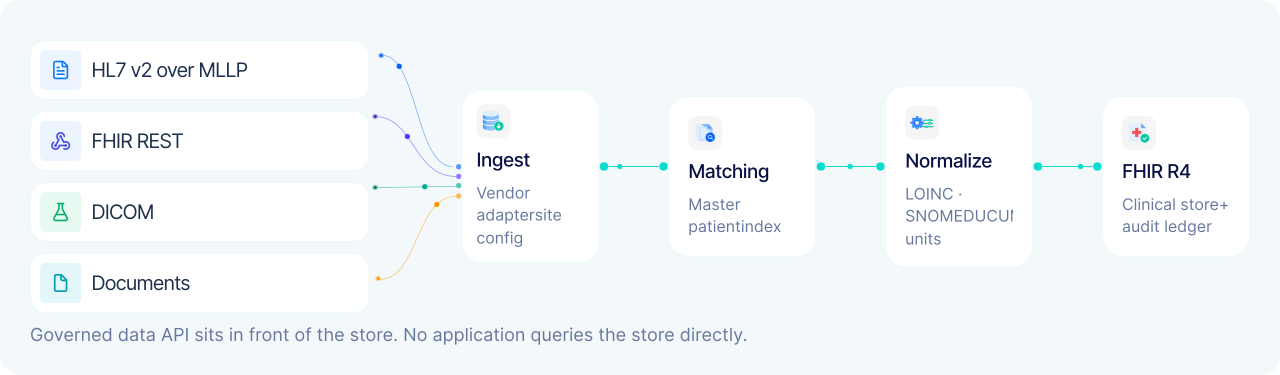
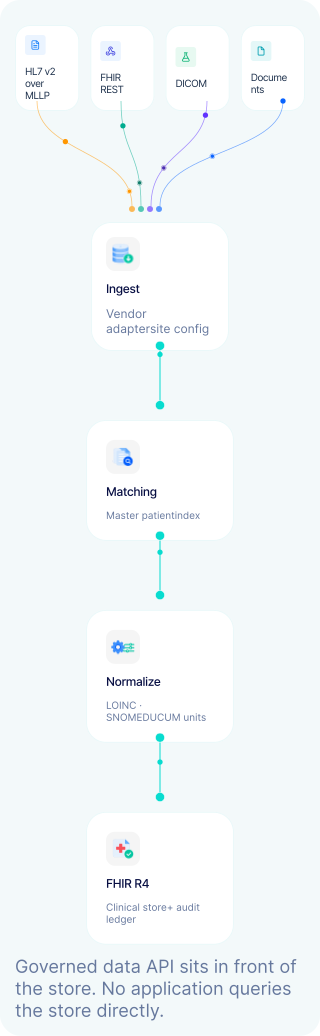
Ingest to store · illustrative
Models in the platform
An application does not hold its own model or reach out to one. It asks the platform, and the platform decides which pinned version answers, on which machine, with which data — under the scopes that application was already approved for.
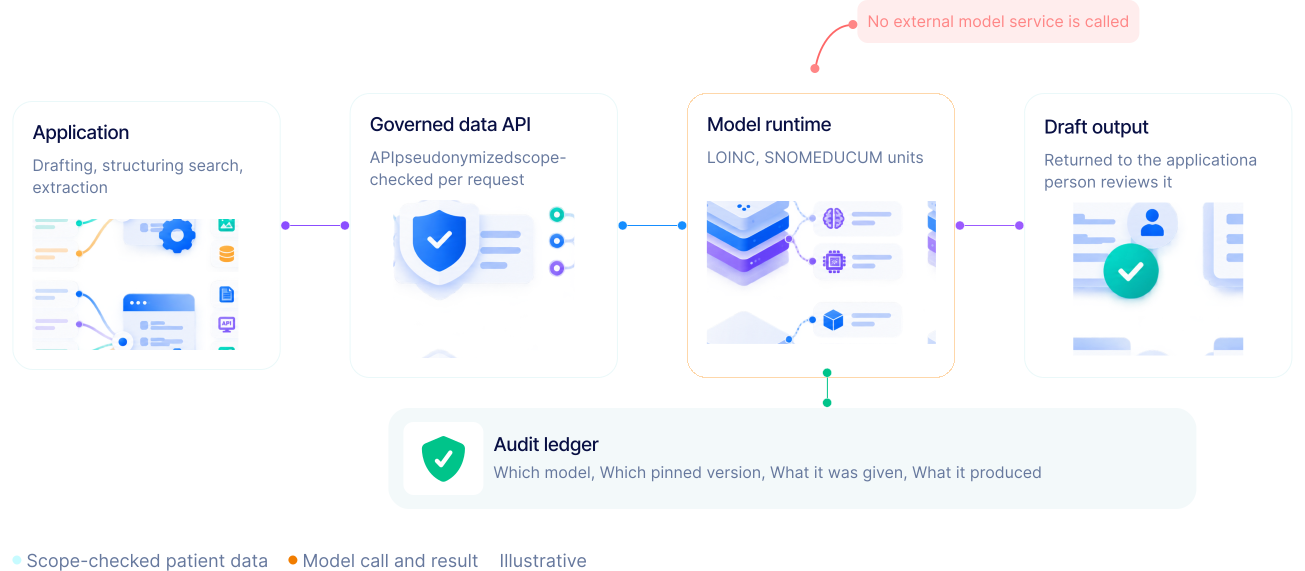

Inference runs on the same pseudonymized, scope-checked view the calling application was approved for. A model is not a way around the access rules.
Which model, at which pinned version, on what it was given, and what it produced — in the same ledger as every other access.

Nothing a model produces reaches a hospital system on its own authority. The platform's write-back approval applies to model output exactly as it applies to anything else.

Free text is treated as containing patient data and is a separate grant, because de-identification of dictated text is not yet good enough to assume otherwise.
Principles
HL7 v2 over MLLP into a vendor adapter, with everything site-specific held in one declarative configuration file rather than in adapter code. FHIR REST and DICOM interfaces follow the same adapter model.

Deterministic rules first. An uncertain match goes to a review queue and is never merged automatically — a wrong merge is far more expensive than a deferred one.

The source code is always kept. LOINC and SNOMED mappings carry provenance, units are converted to UCUM, and quality flags travel with the record rather than being silently corrected.

An open-standard clinical store with platform metadata carried as an extension. If a hospital ever leaves, its data is already in a standard format on its own storage.

An application declares the resources it needs. The hospital approves them once. Every request is checked against that approval, and a refusal is written to the ledger.

Some applications are approved for counts rather than records. Grouped results are pruned inside the query engine before they leave it, so the application receives an already-reduced grid.

Place workloads across the machines a site actually has, with the site choosing whether placement is automatic, proposed for approval, or set by its own rules.

SDK-native or standards-bridged, both under the same scopes, isolation and audit trail. Bridges are built per standard rather than per vendor.

Bare metal, virtualization, Kubernetes, OpenShift, research HPC, or a customer-controlled sovereign tenancy. Not every interface listed on this page is available on every target today.

A hash-chained core with a validated clinical event catalogue on top. Applications never write it — the platform does, from what they return — and the chain can be verified independently.

Models and runtime
The runtime layer holds the model catalogue: what is installed, at which version, under whose licence, and which applications may call it. Every model is version-pinned and recorded, and any of them can be swapped.
Apache 2.0 or MIT only — models that need no negotiated contract. No separate licence, no separate fee, version-pinned, delivered in the signed update bundle and run on your hardware.
 Architected
General drafting and structuring
Gemma 4 (2B–31B), Qwen3.6, gpt-oss-20b, Phi-4
Indian and regional languages
Sarvam-30B, IndicTrans2
Speech to text
Whisper large-v3-turbo, IndicConformer — a draft transcript, reviewed by your staff
Search over records and literature
BGE-M3 and its reranker, Qwen3-Embedding, MedCPT
Reading clinical text
GLiNER-biomed, medspaCy, scispaCy
Research workspace
ESM2, ESM C, Boltz-2, Chai-1
Gemma 4 is the default general model. It became Apache 2.0 in April 2026, and that licence change is the only reason it can be shipped at all — which is how every model on this list is chosen.
Models we support but do not ship. You hold the licence; we integrate them against your intended use, and we confirm what a given licence allows before anything is installed.
 Architected
 Medical language models -MedGemma and Google's health models, Med42, OpenBioLLM, Meditron.Pathology and imagingVendor models -That come with your NVIDIA or cloud agreements.Any cleared third-party product -Hosted under the same controls as everything else.
Bring your own weights.
A model your own team trained runs through the same manifest, scopes, isolation and audit path as any vendor's
 Architected
Version pinning
Every model is pinned and recorded in the ledger alongside what it produced, and any of them can be swapped
ArchitectedSigned update bundles.
Containers, weights and manifests are signed, verified on the appliance, staged, and activated only after a person at your site approves
ArchitectedAir-gapped installs.
The same signed bundle path over removable media, with no outbound connection at all
ArchitectedOutbound-only management.
We never hold an inbound route into a hospital network
ArchitectedArchitecture
Nexus allocates and provisions workloads across the machines a site already owns — against the requester's role and the access their organization approved. The moat is the software, not the device.

Governance
Governance
Who can see what · what ran · what users did · one audit ledger
 NEXUS

Applications and models
Applications and models
Model catalogue
 VENDORS

Data platform
Data platform
Integration · patient matching · cleansing · FHIR R4 · pseudonymized views
 NEXUS
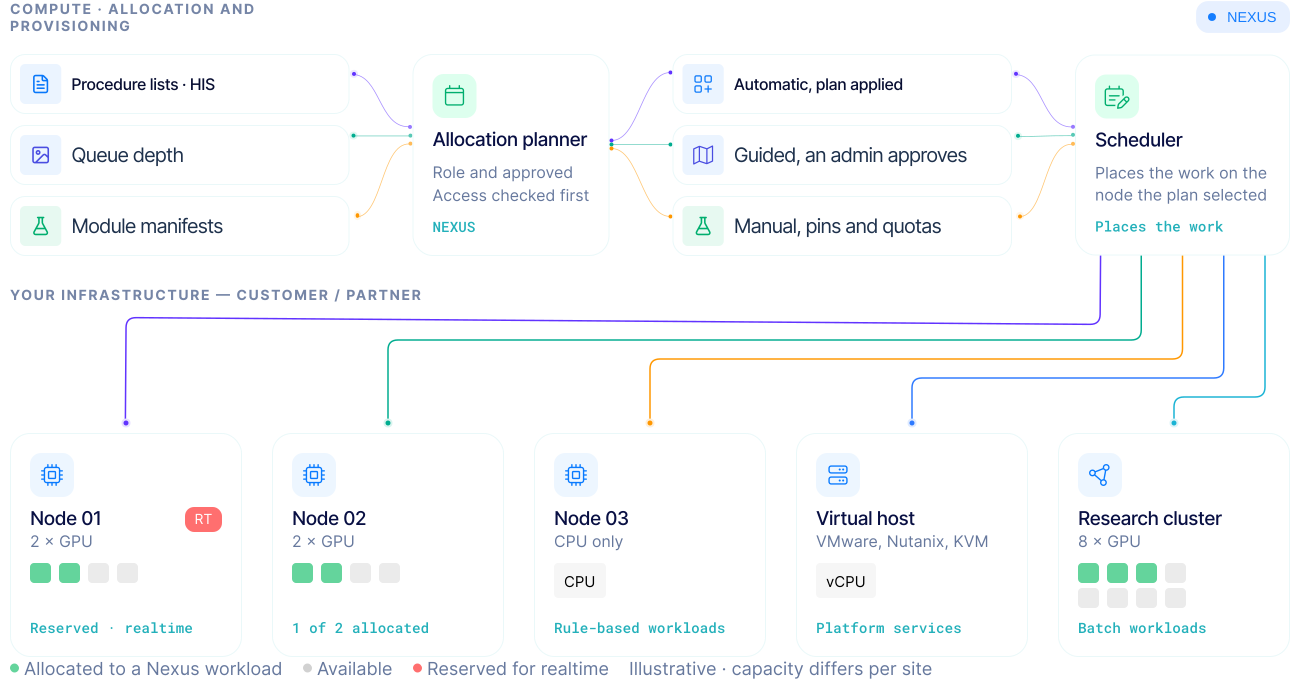

Placement itself is a solved problem and Nexus does not re-solve it. What only Nexus can do is read the hospital's own theatre and endoscopy lists, so capacity is ready before a list starts.
In automatic mode the plan goes straight to the scheduler. In guided mode an administrator approves it first. In manual mode the administrator pins workloads and sets quotas, and the planner reports conflicts.
A request carries who is asking and what their organization approved. A researcher's workspace, a quality report and a clinical workload are not the same request and are not placed on the same terms.
Models in the platform
A hospital group or regional network runs a hub with the full compute pool, the governance console and the application catalogue, with spoke sites that either capture and display only, or hold enough local compute to keep working through a link failure.
Full compute pool, every application, the governance console, and the group's shared catalogue.
Capture and display only. All inference runs at the hub.
Local compute for the latency-sensitive work, syncing to the hub, and able to survive a link failure.
What this costs to run
The diagram above is the shape any competent team would draw. What makes a clinical data platform expensive is not designing it once — it is carrying it, per vendor, per market, per site, for as long as the hospital runs.

One adapter for each HIS, LIS and PACS product — and another each time a vendor ships a release that moves a field. Site-specific mapping stays in configuration, so the adapter itself survives the next hospital.

Terminology and ontology licensing differs by country, and so does what a national licence covers. Patient matching has to hold against transliterated names, not only Latin ones.

A validation run on that hospital's own cases before anything reaches a clinician, and an approval trail a tender can be walked through years later.
Building it once is a project.
Keeping it current is the product.
Availability
A single-host deployment includes a manual fallback for clinical work. Standby and clustered shapes are designed and not built — but the rules that make them possible apply now: services hold no state, the ledger has exactly one writer, and every consumer is idempotent.
Single node
One host. Manual fallback for clinical work, restore from backup
 Available today
Warm standby
Two hosts with the database and object store replicated; promote the standby in minutes
 Roadmap
Clustered
Three or more nodes, stateless services behind a load balancer, database with automatic failover
RoadmapGovernance console
One place where a hospital can see every installed application, the scopes it was granted, and every access it made.

Care Gap Worklist
11 scopes · pseudonymized · events + write-back
 EnabledEnabled


Quality & Audit Pack
4 scopes · aggregate-only · no row access
EnabledEnabled
Evidence Search
0 scopes · no data channel opened
EnabledEnabled
Research Workspace
Aggregate-only · row access requires approval
 2 Approvals pending2 Approvals pending
Vendor imaging application
Standards-bridged · awaiting regulatory eligibility
 Not InstalledNot Installed

Synthetic identifiers only. No real patient data appears in any Nexus interface shown on this site.





See how Nexus can help your organization unlock the value of clinical data with AI — securely and at scale.
For hospitals · research institutions · healthcare AI companies